






Clash Royale is not just about using strong cards. The best players understand deck archetypes: the core strategy behind how a deck wins, defends, cycles, and pressures the opponent.
Most competitive decks fall into six major archetypes: Beatdown, Control, Bait, Bridge Spam, Siege, and Cycle. Supercell has also officially used archetype labels like Bridge Spam, Lava Hound Balloon, X-Bow, Splash Yard, and Log Bait in past deck challenges, which shows how important these categories are for understanding matchups.
This guide explains every major Clash Royale deck archetype, how each one works, common win conditions, strengths, weaknesses, and how to build your own deck around them.
Players who want faster progression can also use Clash Royale Boosting to climb more efficiently while learning these archetypes in real matches.
Table of Contents
What Is a Deck Archetype in Clash Royale?
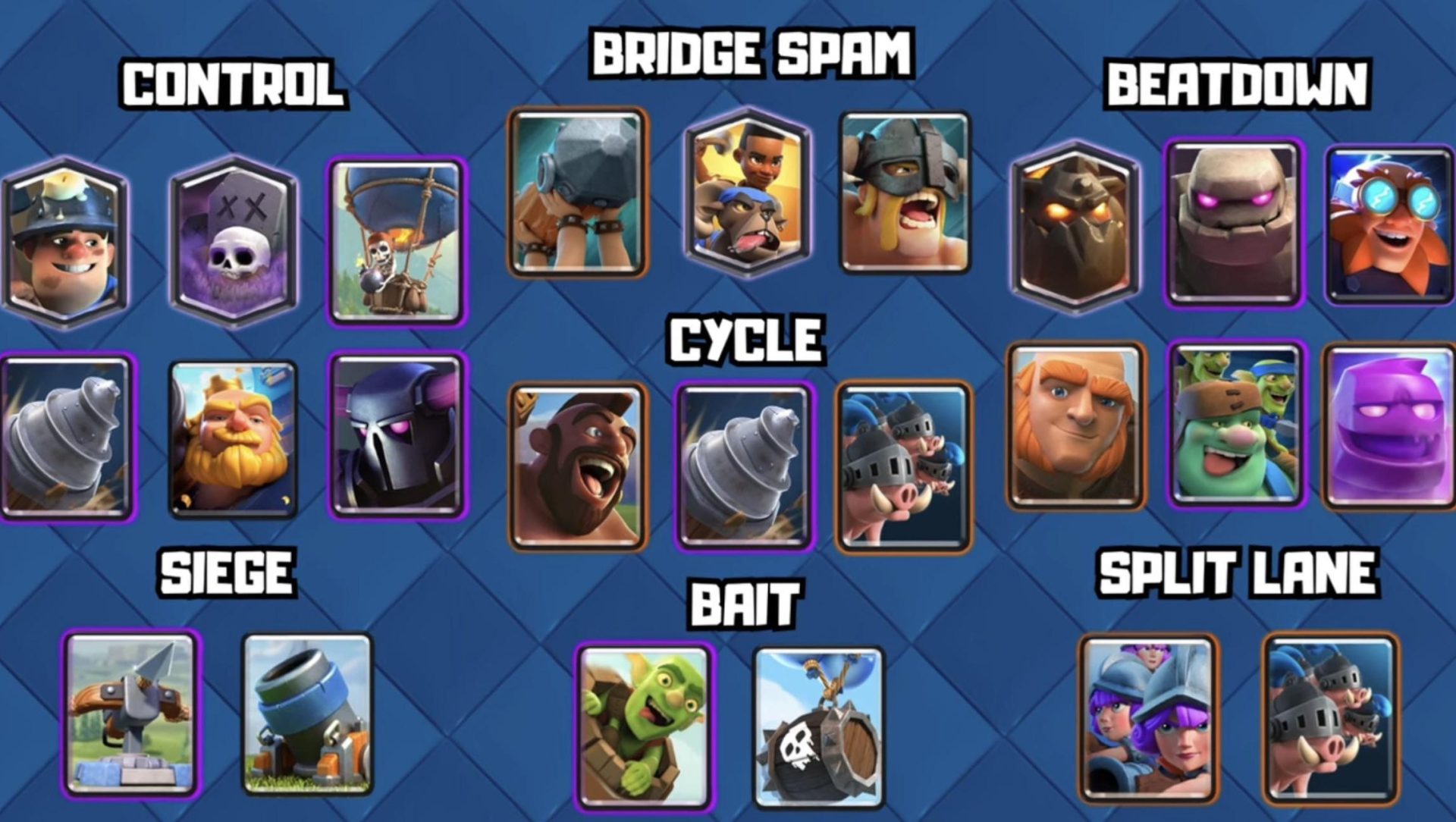
A deck archetype is the main game plan your deck follows to win towers.
For example:
A Golem deck wants to build one huge push.
A Miner Poison deck wants to defend and chip slowly.
A Log Bait deck wants to force out small spells.
An X-Bow deck wants to lock onto the tower from your side of the arena.
Once you understand archetypes, you can read opponents faster. Seeing cards like Princess, Goblin Barrel, and Inferno Tower usually signals Bait. Seeing Golem, Night Witch, and Lightning usually means Beatdown.
That early recognition helps you decide whether to attack, defend, save elixir, or pressure the opposite lane.
All Main Clash Royale Deck Archetypes
The six main deck archetypes are:
- Beatdown
- Control
- Bait
- Bridge Spam
- Siege
- Cycle
Some decks blend multiple styles, but most competitive decks still lean toward one primary identity.
1. Beatdown Decks
How Beatdown Decks Work
Beatdown decks are built around one large tank or heavy win condition. The goal is to create a massive push that overwhelms the opponent.
Common Beatdown win conditions include:
- Golem
- Giant
- Electro Giant
- Lava Hound
- Royal Giant
- Goblin Giant
A typical Beatdown push starts by placing your tank behind the King Tower. As the tank walks forward, you add support cards behind it. By the time the push reaches the bridge, your opponent must deal with a large layered attack.
Example Beatdown Deck
| Card | Elixir |
|---|---|
| Golem | 8 |
| Lumberjack | 4 |
| Night Witch | 4 |
| Baby Dragon | 4 |
| Mega Minion | 3 |
| Zap | 2 |
| Tornado | 3 |
| Lightning | 6 |
Strengths
Beatdown decks are excellent in double elixir because they can build unstoppable pushes. They punish players who overspend and often win by taking a tower in one decisive attack.
Weaknesses
The biggest weakness is cost. If you place Golem in the back and your opponent attacks the opposite lane, you may not have enough elixir to defend properly.
Beatdown players must know when to ignore damage and when to defend.
2. Control Decks
How Control Decks Work
Control decks focus on defense first. Instead of winning with one giant push, they slowly damage the enemy tower while preventing the opponent from breaking through.
Common Control win conditions include:
- Miner
- Graveyard
- Royal Giant
- Mortar
- Goblin Drill
- Wall Breakers
Control decks often use spells like Poison, Fireball, or Rocket to support tower chip and remove defensive troops.
Example Control Deck
| Card | Elixir |
|---|---|
| Miner | 3 |
| Little Prince | 3 |
| Poison | 4 |
| Royal Ghost | 4 |
| Goblin Hut | 4 |
| Barbarian Barrel | 2 |
| Skeletons | 1 |
| Wall Breakers | 2 |
Strengths
Control decks are strong against aggressive players because they turn defense into counterpushes. A good Control player rarely panics and often wins by slowly building a damage lead.
Weaknesses
Control decks require patience and matchup knowledge. If you overcommit on offense, you can lose the defensive structure that makes the deck work.
Players pushing trophies may combine practice with Clash Royale Arena Boost to reach higher arenas where matchup knowledge becomes more important.
3. Bait Decks
How Bait Decks Work
Bait decks force your opponent to waste their key counter, then punish them when that counter is out of cycle.
The classic example is Log Bait. You use cards like Princess, Goblin Gang, and Goblin Barrel to pressure the opponent. If they use The Log on Princess, your Goblin Barrel becomes harder to stop. Supercell describes Classic Log Bait as using low-cost cards to bait small spells while applying steady tower damage.
Common Bait cards include:
- Goblin Barrel
- Princess
- Goblin Gang
- Dart Goblin
- Skeleton Barrel
- Wall Breakers
Example Bait Deck
| Card | Elixir |
|---|---|
| Knight | 3 |
| Princess | 3 |
| Goblin Barrel | 3 |
| Goblin Gang | 3 |
| Inferno Tower | 5 |
| The Log | 2 |
| Rocket | 6 |
| Ice Spirit | 1 |
Strengths
Bait decks apply constant pressure and punish slow or heavy decks. They are especially strong when the opponent only has one reliable answer to your main win condition.
Weaknesses
Bait decks struggle when the opponent has multiple small spells or splash counters. You also need strong timing, because a mistimed Goblin Barrel can waste your best damage opportunity.
4. Bridge Spam Decks
How Bridge Spam Decks Work
Bridge Spam decks win by applying fast pressure at the bridge. Instead of building a large push, you force the opponent to react quickly and punish mistakes.
Supercell has described Bridge Spam simply as dropping many cards at the bridge while watching your elixir carefully, since overcommitting can leave you open to counterattacks.
Common Bridge Spam cards include:
- Battle Ram
- Bandit
- Royal Ghost
- Dark Prince
- Ram Rider
- Lumberjack
- Magic Archer
Example Bridge Spam Deck
| Card | Elixir |
|---|---|
| Battle Ram | 4 |
| Royal Ghost | 3 |
| Ice Golem | 2 |
| Lumberjack | 4 |
| Zappies | 4 |
| Inferno Dragon | 4 |
| Fireball | 4 |
| Zap | 2 |
Strengths
Bridge Spam decks are excellent at punishing low elixir. If the opponent plays a heavy card in the back, you can instantly attack the opposite lane.
Weaknesses
Bridge Spam can become predictable. If your opponent defends calmly and counterpushes, you may run out of answers.
5. Siege Decks
How Siege Decks Work
Siege decks use buildings as win conditions. Instead of crossing the bridge, they attack enemy towers from your side of the arena.
The two most common Siege win conditions are:
- X-Bow
- Mortar
With Siege, your goal is to place your win condition safely, protect it, and force it to lock onto the enemy tower.
Example Siege Deck
| Card | Elixir |
|---|---|
| Archers | 3 |
| Electro Spirit | 1 |
| Knight | 3 |
| X-Bow | 6 |
| Tesla | 4 |
| Fireball | 4 |
| The Log | 2 |
| Skeletons | 1 |
Strengths
Siege decks reward precision. A single X-Bow or Mortar lock can win the match. They also have strong defensive structures and fast cycling tools.
Weaknesses
Siege decks are difficult to master. If your opponent has a heavy tank or strong reset cards, getting a tower lock becomes much harder.
Players interested in testing different card levels and deck styles can also Browse Clash Royale Accounts to compare progression setups.
6. Cycle Decks
How Cycle Decks Work
Cycle decks use cheap cards to return to their win condition faster than the opponent can return to their counter.
Common Cycle win conditions include:
- Hog Rider
- Miner
- Goblin Drill
- Wall Breakers
- Royal Hogs
- Mortar
Cycle decks usually average below 3.0 elixir, though some modern cycle decks can sit slightly higher depending on champions and evolutions.
Example Cycle Deck
| Card | Elixir |
|---|---|
| Goblin Drill | 4 |
| Knight | 3 |
| Goblins | 2 |
| Fire Spirit | 1 |
| Bomber | 2 |
| Poison | 4 |
| Snowball | 2 |
| Cannon | 3 |
Strengths
Cycle decks are fast, flexible, and great at constant pressure. If your opponent’s main counter is out of hand, you can immediately punish them.
Weaknesses
Because Cycle decks use cheap cards, mistakes are costly. Poor placements against tanks, splash troops, or air pushes can quickly lose the game.
How to Identify an Opponent’s Archetype Early
You can often identify a deck from the first three or four cards.
If you see Golem, Night Witch, or Baby Dragon, expect Beatdown.
If you see Miner, Poison, and cheap defenders, expect Control.
If you see Princess and Goblin Barrel, expect Bait.
If you see Bandit, Battle Ram, or Royal Ghost, expect Bridge Spam.
If you see X-Bow or Mortar, expect Siege.
If you see Hog Rider with Skeletons and Ice Spirit, expect Cycle.
Recognizing archetypes early helps you avoid bad trades. For example, against Bait, save your small spell. Against Beatdown, pressure before the big push forms. Against Siege, protect your tower from the first lock.
How to Build Your Own Clash Royale Deck
A strong deck needs balance, not just favorite cards.
Pick a Win Condition
Your win condition is your main tower-damage card.
Good examples include:
- Hog Rider
- Miner
- Golem
- Goblin Barrel
- X-Bow
- Graveyard
- Royal Giant
- Balloon
Heavy decks usually need one main win condition. Lighter decks can sometimes run two, such as Miner plus Wall Breakers.
Add Air Defense
Every deck needs reliable answers to air troops.
Good air defense cards include:
- Musketeer
- Archers
- Baby Dragon
- Electro Wizard
- Phoenix
- Mega Minion
- Inferno Dragon
Without air defense, Lava Hound, Balloon, and Minion Horde can overwhelm you.
Include a Mini Tank
Mini tanks protect support troops and help defend.
Common mini tanks include:
- Knight
- Valkyrie
- Dark Prince
- Royal Ghost
- Ice Golem
- Mighty Miner
Use Two Spells
Most decks should run one small spell and one medium or heavy spell.
Small spells:
- Zap
- The Log
- Snowball
- Arrows
Bigger spells:
- Fireball
- Poison
- Lightning
- Rocket
Spells help remove support troops, finish towers, and control swarms.
Keep Your Average Elixir Realistic
A deck that is too expensive can lose before it gets started. A deck that is too cheap may lack damage or defense.
General ranges:
- Cycle: under 3.0 elixir
- Control: 3.0–3.6 elixir
- Bridge Spam: 3.3–3.9 elixir
- Beatdown: 3.8+ elixir
- Siege: usually 2.9–3.5 elixir
Best Archetype for Beginners
For newer players, Beatdown and simple Cycle decks are usually easiest to understand.
Beatdown teaches push-building.
Cycle teaches elixir discipline.
Bait teaches spell tracking.
Control teaches patience.
Bridge Spam teaches punishment timing.
Siege teaches precision and defense.
The best long-term approach is to learn at least one deck from every archetype. Even if you do not main them, understanding how they work makes you much better at countering them.
Final Thoughts
Clash Royale deck archetypes are the foundation of high-level gameplay. Once you understand Beatdown, Control, Bait, Bridge Spam, Siege, and Cycle, the game becomes easier to read.
You stop reacting randomly and start predicting your opponent’s plan.
Whether you enjoy building huge Golem pushes, defending with Miner Poison, forcing spell mistakes with Log Bait, or locking towers with X-Bow, every archetype rewards a different skill set.
Master the archetypes, learn their matchups, and your deck choices will become much more consistent.
Related Guides

Phasmophobia Willow Street Rework Guide: Complete Map Walkthrough
Phasmophobia Deildegast Guide: Evidence, Abilities, and Zero-Evidence Identification

Clash Royale Chaos Phase 3 Decks: Best Meta Builds & Winning Strategies

Assassin's Creed Black Flag Resynced: How to Beat Julien Du Casse